
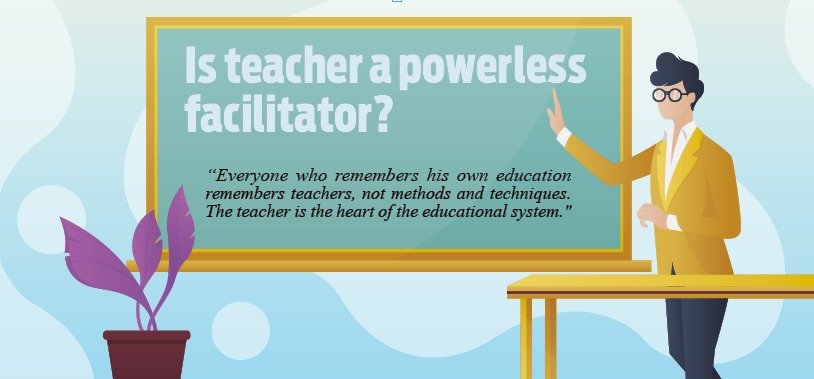
“Everyone who remembers his own education remembers teachers, not methods and techniques. The teacher is the heart of the educational system.”
Sajjad Bazaz
The system of education has undergone a sea change in the past two decades. The demand for educational degrees has ballooned. Today, students have choices in abundance to pursue their education in different streams. Larger institutions while leveraging technology are poaching students through extension campuses and online mode as they want to capitalise on the surging demand to make profits despite being ‘non-profit’ organisations.
Over a period of time, this transformation of education system has been driving competition among the educational institutions to claw for more and more students. One may call this modern system of education, but the fact is that it has stamped the educational degrees as good as consumer goods. Offering the degrees as consumer goods means the institutions are focusing on making money and for making money, they need more and more students.
It’s here the institutions, be it schools, colleges or universities, executed a drastic shift in the way of imparting education. In order to lure students, they offer what students want and unfortunately don’t focus on the areas which a student needs. So, we have a student-defined system of education. Even as Internet has revolutionised the teaching methods and today students are more comfortable to learn their lesson through online mode such as YouTube etc., it has directly complicated, rather marginalised the role of a teacher. In fact, in a student-driven education system, the teacher-student relationship too has witnessed a sad transformation, where institutions have squeezed the role of a teacher as a powerless facilitator and treat students as commercial commodities. Broadly speaking, consumer-driven education system has hit the element of discipline in the teacher-student relationship. Gone are the days, when the system was tailored to make students to submit to the authority of their teachers and this would discipline a student’s mind and heart. Interaction between student and teacher was an essential part of the educative experience. Teachers used to determine not only the subject matter but the structure and purpose of homework. As rightly put by one of my acquaintances, ‘curriculum was not only about growth in knowledge but also growth in maturity.’
Now the model of authority in classrooms has changed. Classrooms most of time stand dominated by students. The growing online system of education, majorly pushed up by the outbreak of coronavirus pandemic, has squeezed the role of a teacher in real sense. This changing authority in classrooms has adversely impacted the teacher-student relationship to a large extent. In fact, teacher feels marginalised in this student-centred classroom environment.
We have to understand that for a teacher it’s not matter of communicating information in line with the curriculum alone, but infusing discipline and maturity in students to grow into self-motivated individuals is also equally important. And in a student-dominated classroom, this mission goes for a toss.
It makes a sense to reproduce a quote from Dr. T. David Gordon’s Why Johnny Can’t Sing Hymns: “The barrier to education is the student himself–his parochialism, his laziness, his reluctance to abandon his current viewpoints, his resistance to disciplined intellectual effort, his complacent self-satisfaction with his present attainment and understanding. Nearly every capable educator in the history of the human race has realized that the least important thing we educators do is disseminate information, which is (especially now) widely available in less expensive formats. What capable educators have always attempted to do is to infect their students with a love of learning and a hatred of parochialism.”
Here I want to make it clear that student-driven education is not bad. But it should not be at the cost of disrespecting teachers. This should in no way allow the students to dictate dos and don’ts of teaching to the teachers.
Meanwhile, in the context of given environment, our teaching community can still play anchor role to shape the future of their students. In the given circumstances, the teachers’ responsibility in classrooms is beyond routine tutoring. A teacher has to act as a guardian of their students when it comes to any violation of their educational rights. It’s the dire need of the hour to protect students’ basic human right to education. They have to understand that they are having one of the most vulnerable sections, the children, under their umbrella. It is also of utmost importance for a teacher to understand that children are unique and gifted in their own way and avoid criticising them as failures to score good marks in their tests. They should always instil honesty and truthfulness in their students.
And one more important and sensitive issue taking toll of teachers’ reputation is moral degradation stories brining disrepute to the student-teacher relationship. Teachers should not forget their roles as mentors and figures of authority. They should not fall into the trap of talking to their students intimately and respect the set boundaries with them.
In the context of teacher’s role, Sidney Hook, a well-known American philosopher, has said, “Everyone who remembers his own education remembers teachers, not methods and techniques. The teacher is the heart of the educational system.”