
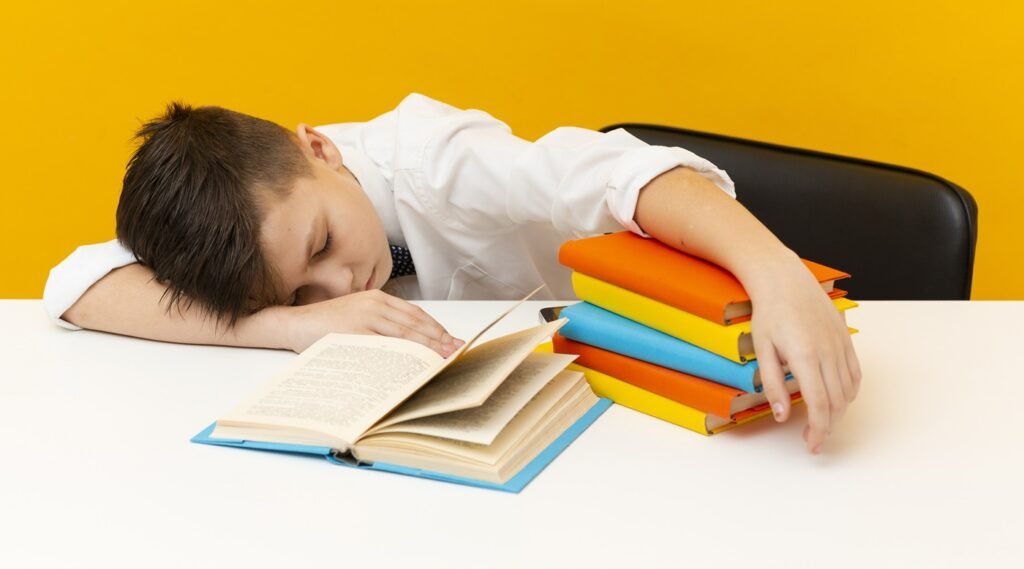
Behind every examination paper is a child who needs encouragement, understanding and above all, the reassurance that a mark sheet can never define their worth.

Gowher Bhat
A child’s marks may appear on a report card, but the fear, pressure and anxiety behind those marks can remain invisible.
For many children, exam season is not simply a time of revision, tests and results. It can become a period of sleepless nights, constant worry and fear of disappointing their parents.
A little nervousness before an examination is normal. But when worry becomes persistent or overwhelming and begins affecting a child’s sleep, concentration, school performance or everyday life, it deserves attention. The American Academy of Pediatrics notes that anxiety in children can affect sleep, school performance and attention, and can sometimes appear through physical symptoms.
This distinction is important because children do not always have the words to explain what they are feeling.
Some may become unusually quiet. Others may become irritable, cry frequently, lose interest in things they normally enjoy or complain of headaches, stomach discomfort or difficulty sleeping. Such changes should not automatically be dismissed as laziness, disobedience or an excuse to avoid studying.
The pressure becomes particularly harmful when children begin to believe that their marks determine their value.
A child who repeatedly hears that only the highest marks are acceptable may start seeing every examination as a test not only of knowledge, but of personal worth. A small mistake can then feel like a major failure.
Parents naturally want their children to succeed. But there is an important difference between encouraging a child to work hard and making the child afraid of failure.
Children need to know that an examination measures their performance on a particular day. It does not measure their intelligence, character, creativity or future potential.
This message becomes especially important during competitive examinations, when children may constantly compare themselves with classmates, siblings or friends.
Mental health problems among young people are not rare. The World Health Organization estimates that one in seven, or about 14.3 per cent, of adolescents aged 10–19 experiences a mental health condition globally.
India faces the same broader challenge. A recent UNICEF India report, citing the 2021 Global Burden of Disease estimate, states that 14 per cent of Indian adolescents aged 10–19 experienced a mental disorder.
These figures do not mean that examinations are responsible for all mental-health problems. Children’s mental health is influenced by many factors, including family relationships, bullying, social pressures, adversity and other experiences. WHO notes that the more risk factors an adolescent is exposed to, the greater the potential impact on mental health.
Academic pressure can therefore become an additional burden for a child who is already struggling.
One of the simplest ways to reduce exam-related pressure is to change the conversation.
Instead of repeatedly asking, “How many marks will you get?”, parents can ask, “How are you feeling?” or “Is there anything you are finding difficult?”
Instead of comparing a child with another student, parents can help the child focus on personal progress.
And instead of treating every mistake as a failure, they can teach children that mistakes are part of learning.
A calm home does not mean a home without expectations. Children can still be encouraged to study seriously, follow a routine and do their best. The difference is that they should not feel that love and acceptance depend on their examination results.
Teachers are often among the first adults to notice changes in a child.
A student who was previously active may suddenly become withdrawn. Another may stop participating in class or appear constantly worried. Some may have difficulty concentrating or become unusually irritable.
Schools can help by creating an environment where asking for help is not seen as weakness. India’s mental-health programmes also recognise the importance of counselling and life-skills support for children and adolescents.
Mental-health education should therefore not be limited to a crisis. Children should gradually learn how to recognise emotions, manage stress, ask for help and support their friends.
During examinations, sleep, food, physical activity and breaks are sometimes treated as obstacles to studying.
They are not.
A tired and frightened child cannot simply be expected to perform better by studying for longer hours.
WHO identifies healthy sleep patterns, regular exercise, coping and problem-solving skills, emotional management and supportive environments at home and school as important for adolescent mental well-being.
The most important thing adults can give children during examination season may not be another study timetable. It may be the assurance that they can talk without being judged.
If a child shows persistent anxiety, sadness, withdrawal, major changes in sleep or a noticeable decline in everyday functioning or school performance, parents should take those signs seriously and consider speaking with a qualified mental-health professional or the child’s doctor. The American Academy of Pediatrics highlights the importance of recognising anxiety when it interferes with areas such as sleep, attention and school performance.
In India, government-supported mental-health services also include Tele-MANAS, which can be reached at 14416. The Ministry of Health and Family Welfare’s Tele-MANAS documentation confirms the use of 14416 for accessing counselling and mental-health support.
Examinations will come and go. Results will eventually become just another page in a child’s school history.
But the way adults respond to children during stressful periods can leave a much deeper impression.
A child who hears, “Do your best; we are proud of you,” learns that effort matters.
A child who hears, “You are a failure if you don’t get the highest marks,” may learn something very different.
Our responsibility is not to remove every challenge from a child’s life. It is to make sure that while children learn to face challenges, they do not feel that they have to face them alone.
Behind every examination paper is a child who needs encouragement, understanding and above all, the reassurance that a mark sheet can never define their worth.
QUOTES:
The American Academy of Paediatrics notes that anxiety in children can affect sleep, school performance and attention, and can sometimes appear through physical symptoms.
In India, government-supported mental-health services also include Tele-MANAS, which can be reached at 14416. The Ministry of Health and Family Welfare’s Tele-MANAS documentation confirms the use of 14416 for accessing counselling and mental-health support.
A calm home does not mean a home without expectations. Children can still be encouraged to study seriously, follow a routine and do their best. The difference is that they should not feel that love and acceptance depend on their examination results.