
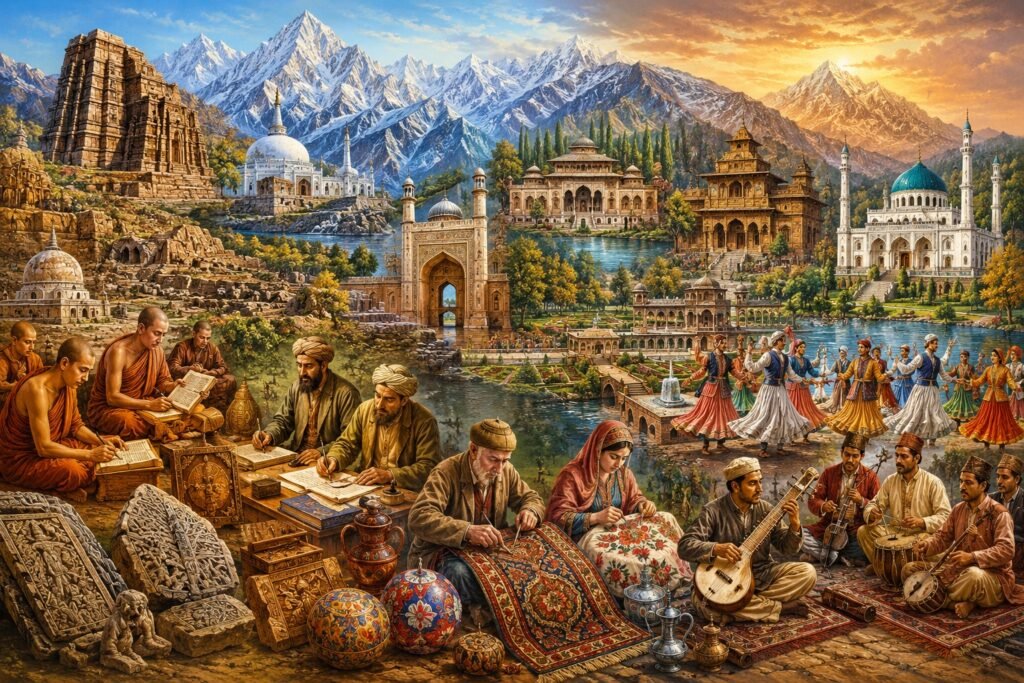
The cultural heritage of Jammu and Kashmir is a remarkable testament to centuries of interaction among diverse civilisations, religions, and communities.Its monuments, literature, languages, crafts, music, cuisine, and festivals collectively represent a unique cultural mosaic that has enriched India’s national heritage and contributed to global cultural diversity. While contemporary challenges such as political instability, globalisation, urbanisation, environmental degradation, and changing socio-economic conditions threaten this legacy, comprehensive conservation strategies involving government agencies, academic institutions, local communities, and civil society can help preserve these invaluable traditions. Protecting the cultural heritage of Jammu and Kashmir is not merelyan act of preserving the past but an investment in cultural identity, social harmony, sustainable development, and the well-being of future generations.
Ancient Period:
The history of Jammu and Kashmir dates back thousands of years. Archaeological discoveries indicate early human settlements in the Kashmir Valley and the Jammu region. Ancient Sanskrit texts, including the Rajatarangini by the historian Kalhana, provide detailed accounts of Kashmir’s political, cultural, and social development. During the Mauryan period under Ashoka, Buddhism spread rapidly across Kashmir. Numerous monasteries, stupas, and centers of learning were established, making the region an important center of Buddhist scholarship. The Kushan rulers further strengthened trade connections with Central Asia through the Silk Road, facilitating exchanges in religion, art, medicine, and philosophy.
Medieval Period:
The medieval period witnessed profound cultural transformation with the arrival of Islam during the fourteenth century. Muslim rulers introduced Persian language, literature, architecture, calligraphy, carpet weaving, and garden design. Rather than replacing existing traditions, Islamic influences blended with indigenous Hindu and Buddhist practices, giving rise to a unique composite culture popularly associated with Kashmiriyat—a tradition emphasizing tolerance, spirituality, and communal harmony. Sufi saints and local mystics played an essential role in promoting peace, social equality, and interfaith understanding.
Mughal Period:
The Mughal era marked one of the most prosperous phases in Kashmir’s cultural history. Emperors such as Akbar, Jahangir, and Shah Jahan admired Kashmir’s natural beauty and commissioned magnificent gardens, palaces, bridges, and public works. Persian art, miniature painting, poetry, architecture, and horticulture flourished during this period.
Dogra Rule:
The nineteenth century witnessed the establishment of the Dogra dynasty. Under Dogra administration, several temples, administrative buildings, roads, educational institutions, and public infrastructure projects were constructed. The Dogra rulers also encouraged Sanskrit scholarship, Persian studies, and preservation of historical manuscripts.
Cultural Diversity of Jammu & Kashmir:
The cultural diversity of Jammu and Kashmir reflects centuries of interaction among different ethnic groups, linguistic communities, and religious traditions.
Religious Diversity:-
The region has historically been home to:
Hinduism
Islam
Buddhism
Sikhism
Christianity
Each community has contributed significantly to the region’s architecture, festivals, literature, and social traditions.
Linguistic Diversity:
Numerous languages are spoken across the region, including:-
Kashmiri
Dogri
Gojri
Pahari
Urdu
Hindi
Balti
Ladakhi
Shina
This multilingual environment has enriched literary traditions and oral storytelling.
Festivals:
Major festivals celebrated include:
Eid-ul-Fitr
Eid-ul-Adha
Shivratri (Herath)
Navratri
Diwali
Lohri
Baisakhi
Losar
Buddha Purnima
Urs celebrations of Sufi saints
These festivals foster social cohesion and preserve traditional customs.
Architectural Heritage:
Jammu and Kashmir possesses remarkable architectural diversity.
Religious Architecture
Important heritage sites include:
Martand Sun Temple
Shankaracharya Temple
Hazratbal Shrine
Raghunath Temple
Amar Mahal Palace
Mughal Gardens
The celebrated Mughal gardens include:
Shalimar Bagh
Nishat Bagh
Chashme Shahi
These gardens combine Persian aesthetics with the natural Himalayan landscape.
Traditional Arts and Handicrafts:
The handicrafts of Jammu and Kashmir are internationally renowned.
Major crafts include:
Pashmina shawls
Kashmiri carpets
Papier-mâché
Walnut wood carving
Chain stitch embroidery
Crewel embroidery
Copperware
Silverware
Basket weaving
These crafts provide livelihoods to thousands of artisan families while preserving centuries-old traditions.
Literature and Intellectual Heritage:
The literary heritage of Jammu and Kashmir spans Sanskrit, Persian, Urdu, Dogri, and Kashmiri literature.
Important literary figures include:
Kalhana
Lal Ded
Nund Rishi
Mahjoor
Dina Nath Nadim
Their writings emphasize spirituality, social harmony, and human values.
Music, Dance and Folk Traditions:
Traditional performing arts include:
Rouf dance
Dumhal dance
Kud dance
Bhand Pather folk theatre
Chakri music
Sufi music
Folk ballads
These traditions continue to preserve community identity and oral history.