
Shaech Editorial Desk
Social Media is perhaps the most talked about communication platform across all age groups and genders. And of course, across geographies. Before deliberating upon the penetration of social media into the lives of human beings at a mass level, let’s begin with the dictionary definition of social media.
“Social Media is websites and applications that enable users to create and share content or to participate in social networking.” Social media is not just limited to posting pictures about holidays online. Social media has gained credibility over the years as a reliable source of information and platform where organisations can interact with audiences.
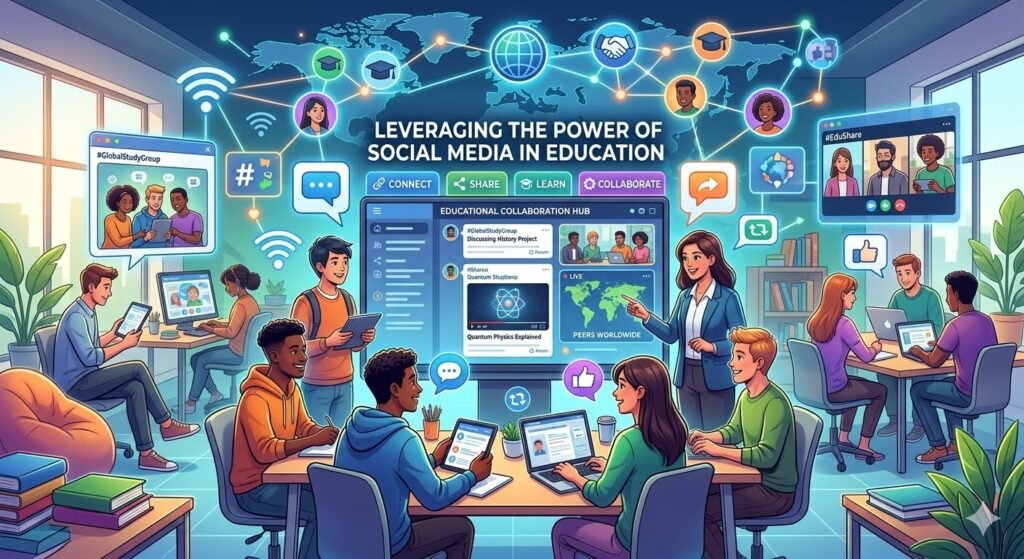
Now let’s get straight to the point – the role of social media in education. We find many education institutions capitalising on the popularity of social media and are adapting these developments into their systems to improve their operations with an aim to make education convenient. Here it needs to be understood that use of social media in education helps all stakeholders – students, teachers and parents – to get more useful information, to connect with learning groups and other educational systems to improve learning methods. Creating a network of resources through social media helps students to benefit from online tutorials through YouTube, online courses delivered by universities abroad.
Experts are of the opinion that “there is valuable knowledge to be gained through social media such as insights on various topics or issues for study purposes. As an educational institution, it is crucial to be active in many social platforms possible, this helps create better student training strategies and shapes student culture.”
“The wonderful thing about using social media in education is that one soon learns who the experts are in different fields and subjects. When one starts following these experts one learns more and gains useful content from them, this empowers them to produce great results,” an expert said.
In other words, we can confidently vouch for the social media having the ability to broaden perspective on various subjects, providing instant access to the content that is new. It provides the opportunity to engage experts to get answers on topics that one may need help in.
The social media networks such as Facebook, Google Plus groups, and YouTube are the channels that can be used to communicate happenings/events within the campus, make announcements and provide students with useful information. This builds engagement between the educational institutes and students. Many student issues can be tackled through group interactions.
Institutions can share supportive and positive posts that reach all students that are connected to the networks and pages. Hashtags can be initiated on social media to engage students and online discussions that are helpful. For instance, a video is a prominent tool in social media that is effective. Creating and sharing useful videos can help students in their course subjects.
To be precise, using YouTube, Facebook or Instagram for live videos can sustain the engagements between students and the institution. As rightly put by experts, “the benefits of social media in the education process doesn’t have to stop at the teacher-student relationship. There are a lot of other benefits that can be extracted from the use of social networking at higher levels as well. For example, principals or administrators can find a new way to integrate social media. Like sharing school news via social networks, holding an online meeting with the parents or even starting fundraising for different projects.”
If the current scenario around the use of social media and its impact on human lives is taken into account, there is no denying the fact that social media can quickly become the only channel of communication in times ahead. In the non-stop fast-paced lives, parents are usually busy with work and cannot physically keep pace with the school meetings.
To be precise, social media has become an integral part of our day to day life and today we cannot think of keeping it away from the system of education. Educational institutions, be it school, college or university, the staff should be encouraged to make use of technology for student and parent communication. The benefits are obvious, starting with healthier parent-teacher relationships and all the way to permanently changing the way children will learn.