
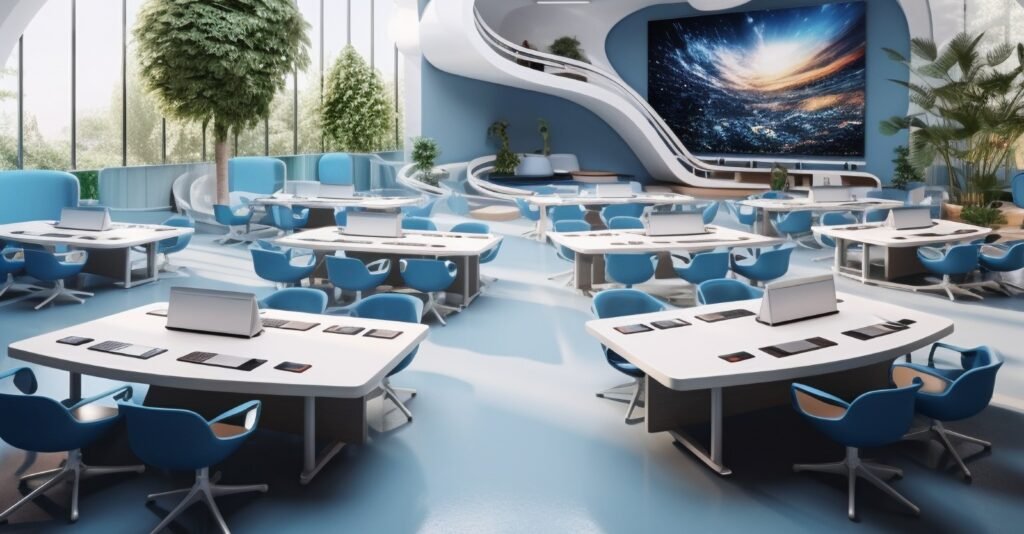
Education, as all of us know, has gone digital. There is no more squeaking chalk and dusty erasers used in the classroom. This is an era of the smart classroom, where learning leaps off from the traditional textbook and onto interactive whiteboards (smart board for teaching), which have quickly become indispensable in sparking richer learning experiences and stronger connections between students and teachers.
Now smart classrooms represent the forefront of educational innovation, transforming traditional learning environments into dynamic and interactive spaces. At the core of this transformation are Interactive Flat Panels (IFPs), which are pivotal in modernising education. These devices facilitate a more engaging, efficient, and collaborative learning experience.
In simpler terms, smart classroom refers to a technologically enhanced learning environment that integrates digital tools and resources to improve teaching and learning outcomes.
Today, more and more schools and education institutionsare now opting for smart classrooms, with an aim to provide students with interactive, engaging, and modern learning experiences. The idea is simple – to leverage technology such as projectors, interactive whiteboards, audio-visual aids, and internet-enabled devices.
The key features of a smart classroom are:
Digital Content Delivery: Smart classrooms use animations, videos, and presentations to make lessons exciting and easier to understand. Imagine watching a volcano erupt or seeing a math problem solved step-by-step in real-time. It’s like learning from a movie!
Interactive Tools: With tools like smart-boards and touch screens, teachers and students can directly interact with the content. Solve problems together, draw diagrams, or highlight key points—it’s all hands-on!
Cloud-Based Resources: With the right resources in the smart classroom, teachers can upload materials like study guides and assignments to the cloud, and students can access them anytime, anywhere. It’s like having your classroom anytime, anywhere.
EdTech Integration:Software applications, AI-driven tools, and learning management systems (LMS) are used to monitor progress, customise learning paths, and provide real-time feedback.
Blended Learning Opportunities: Smart classrooms often support a mix of traditional teaching methods and technology-driven learning, promoting better engagement and understanding.
Essentially, a smart board in classroom takes advantage of educational technology equipment such as laptops, tablets/smartphones, projectors, interactive whiteboards, document cameras, multimedia players, speakers, and microphones to make learning better and more engaging.
Advantages of Smart Classrooms
Smart classrooms offer wonderful benefits, including:
Enhanced learning through technology
When we talk about learning with the help of technology in smart classrooms, it means students get to see lessons come to life before their eyes. One example would be science students watching a volcano erupt on a big screen. Or perhaps history students taking a virtual tour of ancient Egypt.
Multimedia tools like videos and animations mean learners are not just memorising; they’re experiencing. By seeing and interacting with educational content in so many different ways, students find it easier to understand and remember complex subjects.
Increased student engagement and participation
Smart board for teaching pulls students into the heart of lessons in ways that grab their attention. In math classes, for instance, students solve problems on interactive boards, and it feels like playing a game—but with equations. Or perhaps language classes where they can click on words to hear pronunciations which beats struggling through text.
With smart classrooms, your students are no longer passive listeners. They are active participants who are more likely to ask questions, try new things, and really own their learning journey.
Limitations of Smart Classrooms
Now, despite the advantages, there are caveats you might want to consider before transitioning into a smart classroom:
Initial cost and ongoing maintenance
Investing in top-notch educational technology, like interactive flat panel (smart board for teaching) and student tablets, alongside advanced software licenses, comes with a mega price tag. And the financial commitment doesn’t stop there. It extends to ongoing tech support, regular software updates, and necessary equipment upgrades over time. It’s true that not all educational institutions can manage this comfortably.
Training required for effective use
While teachers are experts in their subject areas, introducing technology into the classroom may bring additional learning curves for some who have gotten used to chalkboard teaching. In other words, teachers must become proficient with the latest educational technology tools, but it’s a process that demands both time and, often, extra resources for professional development.