
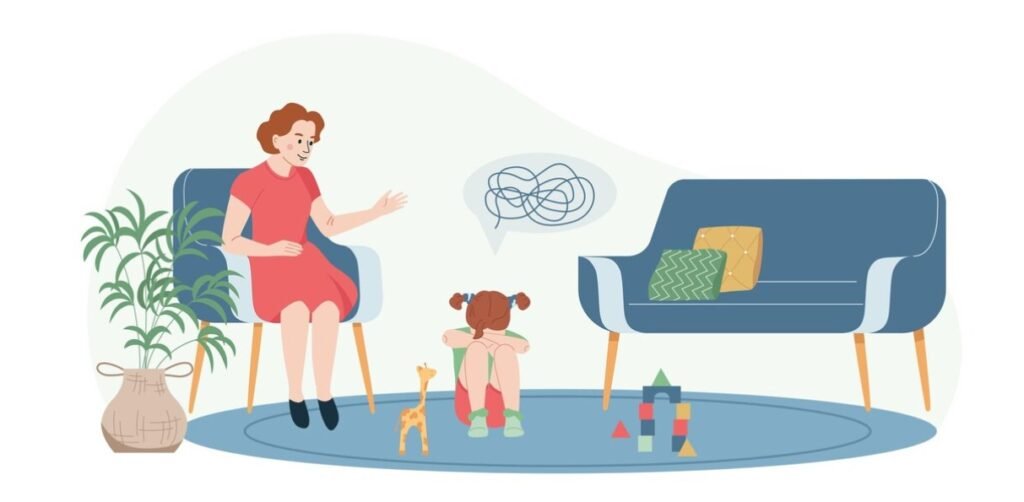
Children struggling with their behaviour is not good for family. It always leaves a negative impact on every member of the family. It’s not that parents don’t want to respond to the behaviour of their children, but they often aren’t sure what’s the best strategy to negotiate the behaviour of their children. The problem compounds when a child is frequently acting out and nothing seems to work.
Let’s first understand why do some children struggle with problem behaviour?
When children have frequent emotional outbursts, it can be a sign that they haven’t yet developed the skills they need to cope with feelings like frustration, anxiety, and anger. Handling big emotions in a healthy, mature way requires a variety of skills, including:
- Impulse control
- Emotional self-regulation
- Problem-solving
- Delaying gratification
- Negotiating
- Communicating wishes and needs to adults
- Knowing what’s appropriate or expected in a given situation
Other children may seem to struggle more with boundaries and following rules. They may be defiant, or ignore instructions or try to talk their way out of things that aren’t optional. You may notice patterns of behaviour that seem to crop up at certain times of the day (like bedtime) during certain tasks (like during homework) or with certain people. You also might notice that your child acts out particularly when they are at home but not when they are at school, or vice versa.
Tantrums and other kinds of acting out are often a normal and even healthy part of childhood. They are a sign that a child is becoming more independent — indications that a child is testing boundaries, developing skills and opinions, and exploring the world around them.
But when a child is acting out a lot, it can strain the parent-child relationship, creating regular frustration and resentment that isn’t healthy in the family. Whether your child is in the early stages of learning about self-regulation and boundaries, or if your family has been struggling and you are looking for help, here a guide designed by behaviour experts is reproduced to explain more about how kids learn to manage their behaviour, what parents can do to aid in the process, and how to get more support if you need it.
Tantrums can be a learned behaviour
Sometimes parents feel that tantrums and other instances of problem behaviour are intentional or manipulative. However, clinicians who specialise in children’s behaviour agree that tantrums are generally not a voluntary behaviour on a child’s part, but they may be what is known as a “learned behaviour.” That means that kids learn that having a tantrum gets them the result that they want.
In other words, while a child who struggles to control their emotions might not be consciously calculating their tantrums, they might resort to them because they haven’t learned a better way to solve problems or communicate their needs. Well-meaning parents often respond to tantrums by trying to fix whatever caused the problem — by comforting the child or giving them whatever they are asking for. Unfortunately, this reinforces the tantrum behaviour, making kids more likely to continue having tantrums and less likely to develop more sophisticated ways to manage their feelings.
Responding to Problem Behaviour
When kids are acting out parents often feel powerless. You may have tried different techniques for discipline but without much success. In fact, trying too many different strategies for managing disruptive behaviour can sometimes be part of the problem, since kids respond better to firm boundaries that are consistently reinforced. But if you haven’t seen progress before now, don’t feel discouraged, because parents have more power than they may realise when kids are being oppositional. By using strategies that are informed by child psychologists who specialise in behaviour management, you can begin to improve kids’ behaviour and even improve the parent-child relationship.
Tips for responding in the moment:
- Don’t give in. Resist the temptation to end your child’s tantrum by giving them what they want when they explode. Giving in teaches them that tantrums work.
- Remain calm. Harsh or emotional responses tend to escalate a child’s aggression, be it verbal or physical. By staying calm, you’re also modelling for your child the type of behaviour you want to see in them.
- Ignore negative behaviour and praise positive behaviour. Ignore minor misbehaviour, since even negative attention like reprimanding or telling the child to stop can reinforce their actions. Instead, provide lots of labeled praise on behaviours you want to encourage. (Don’t just say “good job,” say “good job calming down.”)
- Use consistent consequences. Your child needs to know what the consequences are for negative behaviours, such as time-outs, as well as rewards for positive behaviours, like time on the iPad. And you need to show them you follow through with these consequences every time.
- Wait to talk until the meltdown is over. Don’t try to reason with a child who is upset. You want to encourage a child to practice negotiating when they’re not blowing up (and you’re not either).
Targeting specific behaviours
When you are trying to manage disruptive behaviour, it is helpful to identify specific behaviours that you are trying to change (or encourage). It’s true that when families are feeling overwhelmed, sometimes it can seem like every interaction is a struggle. However, identifying specific behaviours is an important first step to effective discipline. Taking behaviours one at a time allows you to be more focused, gain a better understanding of why the behaviour is happening, and have a greater sense of control. Of course, there may be multiple behaviours that you would like to change, but evaluating them one by one is important.
Target behaviours should be:
- Specific (so expectations are clear to everyone in the family)
- Observable
- Measurable (so everyone can agree whether or not the behaviour happened)
An example of a poorly defined behaviour is “acting out” or “being good.” A well-defined behavior would be running around the room (bad) or starting homework on time (good).
Things that lead to misbehaviour
- Assuming your expectations are understood: Kids may not know what is expected of them – even if you assume they do. Demands change from situation to situation and when children are unsure of what they are supposed to be doing, they’re more likely to misbehave.
- Calling things out from a distance: Tell your children important instructions when you are face-to-face. Directions that are yelled from a distance are less likely to be remembered and understood.
- Transitioning without warning: Transitions can be hard for kids, especially if they are in the middle of doing something they enjoy. When kids are given a warning and have a chance to find a good stopping place, transitions can be less fraught.
- Asking rapid-fire questions, or giving a series of instructions: Delivering a series of questions or instructions limits the likelihood that children will hear, answer questions, remember the tasks, and do what they’ve been instructed to do.
Things that can bolster good behaviour.
- Adjusting the environment: Try to manage environmental and emotional factors that can make it much more difficult for children to rein in their behaviour. Things to consider: hunger, fatigue, anxiety, or distractions. When it’s homework time, for instance, remove distractions like screens and toys, provide snacks, establish an organised place for kids to work, and make sure to schedule some breaks.
- Making expectations clear: You and your child should be clear on what’s expected. Even if they “should” know what is expected, clarifying expectations at the outset of a task helps head off misunderstandings down the line.
- Providing countdowns for transitions: Whenever possible, prepare children for an upcoming transition. For example, give them a 10-minute warning when it is time to come to dinner or start homework. Then follow up when there are 2 minutes left. Just as important as issuing the countdown is actually making the transition at the stated time.
- Letting kids have a choice: As kids grow up, it’s important they have a say in their own scheduling. Giving a structured choice — “Do you want to take a shower after dinner or before?” — can help them feel empowered and encourage them to become more self-regulating.
Consequences that don’t have desired effect.
- Giving negative attention: It seems counterintuitive, but consequences that seem negative to us (like raising your voice or spanking) can sometimes reinforce the very behaviour we are trying to prevent. That’s because children value attention from the important adults in their life so much that any attention – positive or negative – is better than none. That’s why negative attention can actually increase bad behaviour over time. Responding to behaviours with criticism or yelling can also adversely affect children’s self-esteem.
- Delayed consequences: Immediate consequences are the most effective. Children are less likely to link their behaviour to a consequence if there is a lot of time between the two, which means delayed consequences are less likely to actually change a child’s behaviour.
- Disproportionate consequences: Parents can sometimes become so frustrated that they overreact when giving consequences, which is understandable. However, a huge consequence can be demoralising for children, and they may give up even trying to behave.
- Consequences that are accommodating: When a child is slow to doing something you want them to do, like picking up their toys, many parents will become frustrated and just do it themselves. While this reaction is also understandable, it also increases the likelihood that they will dawdle again next time.
Consequences that are effective
- Positive attention for positive behaviours: Praising children when you “catch them being good” makes them more likely to repeat that good behaviour in the future. Positive attention is also a good thing for the parent-child relationship, improves a child’s self-esteem, and feels good for everyone involved.
- Ignoring actively: This consequence might seem counterintuitive, but child behaviour experts often teach “active ignoring” as an effective behaviour management strategy. To perform active ignoring, deliberately withdraw your attention when a child starts to misbehave. As children learn that acting out doesn’t get them your attention, they will begin to do it less. An important component of active ignoring is to immediately give a child positive attention as soon as they exhibit behaviour you do want to see, like sitting calmly. Of course, this consequence should be used only for minor misbehaviour — active ignoring is not appropriate when a child is being aggressive or doing something dangerous.
- Reward menus: Rewards are a tangible way to give children positive feedback for desired behaviours. Rewards are most motivating when children can choose from a variety of desirable things: extra time on the iPad, a special treat, etc. Rewards should be linked to specific behaviours and always delivered consistently.
- Time-outs: Time-outs are one of the most effective consequences parents can use but also one of the hardest to do correctly. It’s very important to balance them with other nurturing techniques, like providing positive feedback and modelling emotional regulation for your child. The next section in the guide gives parents tips on how to have a successful time-out.