
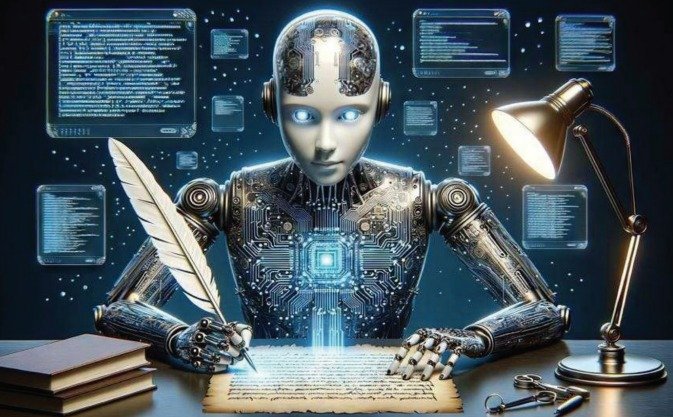
ChatGPT’s release in 2022 brought generative AI into the conversation. In 2025, many experts anticipate generative AI will become even more powerful, bringing AI-led transformation to various spaces.
While traditional AI is excellent for accomplishing preset tasks, such as data analysis, pattern recognition, and predictive analytics, generative AI is capable of producing original content based on its inputs.
Like traditional AI, early forms of generative AI have been around for some time, but the technology has only gained sophistication and widespread use within the last few years. The first chatbots emerged in the 1960s. With the developments in machine learning and generative adversarial networks (GANs), generative AI has entered a new era. Today, generative AI can create realistic images, generate content such as graphics and text, answer questions, explain complex concepts, and convert language into code.
So, what exactly
is Generative AI?
Generative AI is a type of AI that uses deep learning techniques to create new content, such as images, music, animation, 3D models, and text.
There are many types of deep learning models used in generative AI, including GPT-n (ChatGPT is a chat application based on the GPT models), the aforementioned generative adversarial networks, and recurrent neural networks, a deep learning algorithm that recognizes patterns in data sequences such as natural language or time series. This list is not exhaustive.
Generative AI can take raw dataand “learn” to generate statistically probable outputs when prompted. At a high level, generative models encode a simplified representation of their training data and draw from it to create a new work that’s similar, but not identical, to the original data.
How Generative AI Works
Generative AI models are trained on large datasets that contain examples of the content they will generate. They learn to recognize patterns and features within this data and develops an understanding of the underlying structure. Once trained, a model can generate new, original content that mirrors the characteristics of the data it has seen before.
Generative AI often uses advanced neural network architectures, such as the previously mentioned generative adversarial networks (GANs) or variational autoencoders (VAEs). GANs consist of a generator and a discriminator. The generator creates new content, while the discriminator evaluates its authenticity. The two networks compete, improving each other over time. VAEs encode input data into a compressed latent space and then decode it to generate new, similar data.
The quality of the generated content is evaluated, and feedback is used to refine the model and improve its output to meet specific requirements or preferences.
Advantages
Generative AI offers a significant array of abilities. It can respond to questions, revise content, correct code, and even create songs, among other things. Use cases apply across various industries, and developers continue exploring its advantages for numerous different businesses.
Some significant advantages of generative AI are:
Improved creativity and personalization: Generative AI has the ability to create new content. It aids in crafting personalized campaigns, creating engaging written, visual, and audio content, and making digital interactions more personal.
Delightful customer service: Generative AI has the power to analyze customer data to identify trending topics and customer sentiment, which can be used to provide a better experience.
Saving Time: Generative AI can perform data processing in real time and automate tasks, offering significant savings in both time and operational costs.
Boost productivity: Generative AI can provide valuable employee support, including answering questions, finding information, and summarizing content. Additionally, it allows usersto focus more on other tasks as AI can handle time-consuming tasks. It can generate reports automatically to save time, minimize mistakes, and even help speed up the timeline for app development by making coding suggestions.
Improved learning: Generative AI uses new data and feedback to refine its performance. This ability to engage in adaptive learning can help users learn more effectively, too. Models can adjust according to an individual’s learning styles and preferences, enhancing education and knowledge discovery and summarizing complex information in an understandable manner.
Disadvantages
The ethical implementation and use of generative AI remains a concern. With generative AI, the potential for distributing intentionally or unintentionally harmful content, copyright issues, and data privacy concerns are among the potential disadvantages that must be addressed.
Other potential drawbacks pointed out by the experts include:
Compromised brand reputation: Chatbots powered by generative AI can occasionally produce wrong, misleading, or offensive responses. This spotlights the potential for generative AI to have a harmful effect, which can significantly damage a brand’s reputation.
Inadequate sourcing: Generative AI can sometimes identify the sources it bases its results on, but not always.
Inappropriate use: Generative AI can be transformative when used responsibly, but it’s not the right choice for every situation. For example, any scenario that requires empathy or moral context or those where health and legality are on the line should have a human in charge, not AI.
Possible bias: It’s easy to assume AI is always correct, but that’s not always the case, requiring careful use and sensitivity to the potential for bias.
(SHAECH Editorial Desk)